← Back
Article image
πŸ“° News ⏱ 2 min
πŸ”‘

Key Points

5 points
1

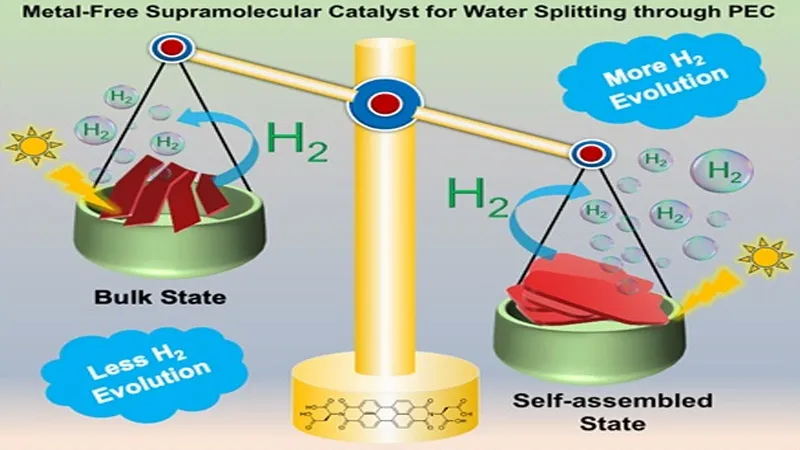
Linked aspartic acid with perylene diimide to form a new material

2

Molecules self‑assemble into ordered nanosheets in water

3

Nanosheets improve sunlight capture and electric charge movement

4

Achieved about 18 % more photocurrent in solar water splitting

5

Provides a metal‑free, greener path to produce hydrogen fuel

πŸ“–

Summary

The combined molecules self‑assemble in water into highly ordered two‑dimensional nanosheets, enhancing light absorption and charge transport.

This structure generated roughly 18 % higher photocurrent during solar‑driven water splitting compared with the bulk material.

The study suggests that using naturally occurring amino acids can guide supramolecular organization for efficient, sustainable green hydrogen production.

πŸ“˜

New Words to Learn

14 words
self‑assembling
when tiny parts automatically join together in a pattern
organic
made from carbon‑based molecules, like those in living things
photocatalyst
a material that uses light to speed up a chemical reaction
hydrogen
a light gas that can be used as clean energy
hydrogen bonding
a weak attraction that helps molecules stick together
pi‑pi stacking
flat parts of molecules stacking like a pile of cards
photocurrent
electric flow created when light hits a material
density functional theory
a computer method scientists use to study how atoms behave
dipole moment
a measure of how a molecule’s positive and negative parts are arranged
supramolecular
structures made from many molecules working together
nanomaterial
material made of extremely tiny parts, invisible to the eye
amino acid
building blocks that make up proteins in living things
charge separation
splitting positive and negative electric parts inside a material
nanosheet
a sheet only a few billionths of a meter thick
πŸ”— Read Full Article β†’

Want to learn even more? Click here to read the full story!

πŸ”Š Reading Article
Kid-friendly voice
πŸ†

New Badge Unlocked!

Badge Name
Badge description