← Back
Article image
πŸ“° News ⏱ 2 min
πŸ”‘

Key Points

8 points
1

India's agricultural sector recorded a 4.45% decadal growth from 2016 to 2025, the highest in recent history.

2

Intensive cultivation, heavy chemical use, and erratic rainfall threaten soil health and farm productivity.

3

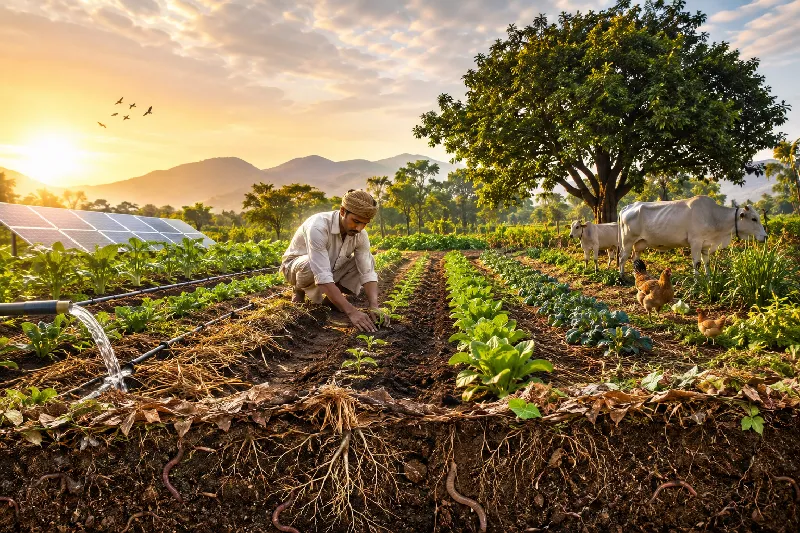
Regenerative agriculture seeks to reverse soil degradation by enhancing organic matter, water holding capacity, and ecosystem diversity.

4

Micro‑irrigation systems (drip and sprinkler) deliver water efficiently, reducing waste.

5

Natural farming uses on‑farm biological inputs such as Beejamrut and Jeevamrut, promotes multi‑cropping, mulching, and livestock integration.

6

Agroforestry integrates trees with crops, providing additional income, moderating temperature, and storing carbon.

7

Government incentives include up to four thousand Indian rupees per acre per year for natural farming, and billions of Indian rupees allocated to micro‑irrigation and integrated farming programs.

8

As of early 2026, over 18.7 million farmers have joined natural farming clusters covering approximately 8.8 million hectares.

πŸ“–

Summary

Key principles include minimizing soil disturbance, maintaining ground cover, protecting living roots, integrating livestock, limiting chemical inputs, and boosting biodiversity.

Practices such as micro‑irrigation, natural farming, green manuring, cover cropping, and agroforestry are promoted to make farms more resource‑efficient and climate‑resilient.

The Indian government supports these methods through schemes like the National Mission on Natural Farming, Per Drop More Crop, Rainfed Area Development Programme, and the Soil Health Card Scheme.

By improving soil structure and reducing reliance on synthetic inputs, regenerative agriculture aims to secure livelihoods and contribute to climate‑action goals.

πŸ“˜

New Words to Learn

8 words
holistic
Looking at the whole system, not just one part
biodiversity
A variety of living things—plants, animals, insects—living together
micro‑irrigation
Small, precise water delivery systems that give water directly to plant roots
green manuring
Growing special plants and then turning them into the soil to add nutrients
cover cropping
Planting crops that stay on the ground to protect it from erosion and keep moisture
agroforestry
Combining trees with crops or livestock on the same land to improve the environment
carbon storage
Keeping carbon in the soil, which helps reduce greenhouse gases in the atmosphere
climate‑resilient
Able to withstand changes in weather and temperature
πŸ”— Read Full Article β†’

Want to learn even more? Click here to read the full story!

πŸ”Š Reading Article
Kid-friendly voice
πŸ†

New Badge Unlocked!

Badge Name
Badge description